
A jaw flare can seem to arrive overnight.
You wake up and your face feels tired. Chewing suddenly takes more effort. There is an ache near the ear that was not there yesterday, or the muscles along your jaw feel as though they have spent hours holding something they were never meant to carry.
If you have experienced this before, there is usually one question somewhere beneath the discomfort:
How long do TMJ flare-ups last?
There is no single timeline.
For some people, symptoms begin to settle within several days. Cleveland Clinic notes that some people with temporomandibular disorders feel better within a week or two, while others experience symptoms that require ongoing care. The National Institute of Dental and Craniofacial Research also notes that many TMDs are short-lived and resolve on their own, although some become persistent or chronic.
The length of a flare often depends on what is happening beneath the surface.
Sometimes the muscles are exhausted from clenching.
Sometimes the joint itself is irritated.
Understanding that difference can help make sense of why one episode disappears quickly while another seems reluctant to leave.
First, What Is a TMJ Flare-Up?
"TMJ flare-up" is a phrase people commonly use to describe a temporary increase in jaw symptoms.
Technically, TMJ refers to the temporomandibular joint itself. The medical term TMD, or temporomandibular disorder, describes conditions affecting the jaw joints, the muscles responsible for jaw movement, or both. There are more than 30 conditions within the broader TMD category.
That matters because two people describing a "TMJ flare" may not be experiencing the same thing.
One person's discomfort may be largely muscular after several nights of grinding.
Another person's symptoms may involve inflammation or irritation within the joint.
Both can feel like jaw pain. The underlying story is different.
So, How Long Can a TMJ Flare-Up Last?
A mild episode related to muscular overuse may begin easing after the behavior irritating the jaw settles down.
For some people, that means improvement within a week or two. For others, discomfort lasts longer or repeatedly returns. Mayo Clinic notes that TMJ-related pain and discomfort are limited in duration for many people, while NIDCR recognizes that some TMDs can become long-lasting.
There is no medically established countdown where a TMJ flare should disappear by a particular day.
The better question may be whether the symptoms are gradually improving.
A jaw that feels slightly softer every morning is different from pain that is becoming stronger or movement that is becoming more restricted.
The direction matters as much as the duration.
Why Some TMJ Flare-Ups Last Longer
The jaw rarely becomes irritated without continuing to participate in everyday life.
Even when it hurts, you still have to speak. You still need to eat.
Then there are the movements happening outside of conscious awareness.
Clenching and grinding, also known as bruxism, can keep the chewing muscles active when they would otherwise be resting. Gum chewing, nail biting, and other repetitive jaw habits can add additional work to an already sensitive area. Stress may also influence clenching patterns for some people.
This can create a frustrating cycle.
The muscles become irritated.
You continue clenching.
The tissues never quite receive the rest they were asking for.
This is one reason awareness of your jaw during a flare can be surprisingly meaningful.
Muscle Tension and Joint Pain Can Feel Similar
One of the most useful things to understand about TMD is that pain near the joint does not necessarily mean the joint itself is damaged.
The muscles responsible for chewing can also create significant discomfort.
TMD symptoms may include pain in the chewing muscles or jaw joint, stiffness, limited movement, and discomfort that spreads into the face or neck.
Muscular tension can also create a tired, heavy sensation through the lower face.
This is where the experience can become confusing.
You feel pain near the TMJ, but the masseter or another chewing muscle may be contributing to what you feel.
That distinction is also part of why persistent symptoms deserve evaluation by a dentist, physician, or clinician trained in orofacial pain rather than relying on symptoms alone.
The Quiet Role of Clenching
Clenching can be difficult to recognize because there may be no dramatic grinding sound.
The teeth simply stay together.
The jaw muscles remain gently contracted.
Minutes become hours.
Eventually, this low-level effort can feel anything but gentle.
During a TMJ flare-up, notice what your jaw is doing when you are not using it.
Are your teeth touching while you read?
Do you tighten your mouth when concentrating?
Does your jaw seem to rise with your shoulders when the day becomes stressful?
NIDCR includes reducing habits such as jaw clenching among the conservative self-care measures commonly recommended when jaw muscles or joints become uncomfortable.
Sometimes the first step toward release is simply realizing you are holding on.
What Can You Do During a TMJ Flare?
For many uncomplicated TMD symptoms, experts recommend beginning conservatively.
NIDCR notes that initial care may include temporarily choosing softer foods, applying heat or cold, performing appropriate jaw exercises when recommended, and reducing behaviors that strain the jaw. Short-term over-the-counter anti-inflammatory medications may also be recommended by a healthcare professional when appropriate for the individual.
The guiding idea is simple.
Give the irritated structures less work to do.
A flare is rarely the moment to test how wide you can open your mouth or chew through something unusually tough.
There can be wisdom in letting the jaw have a quieter few days.
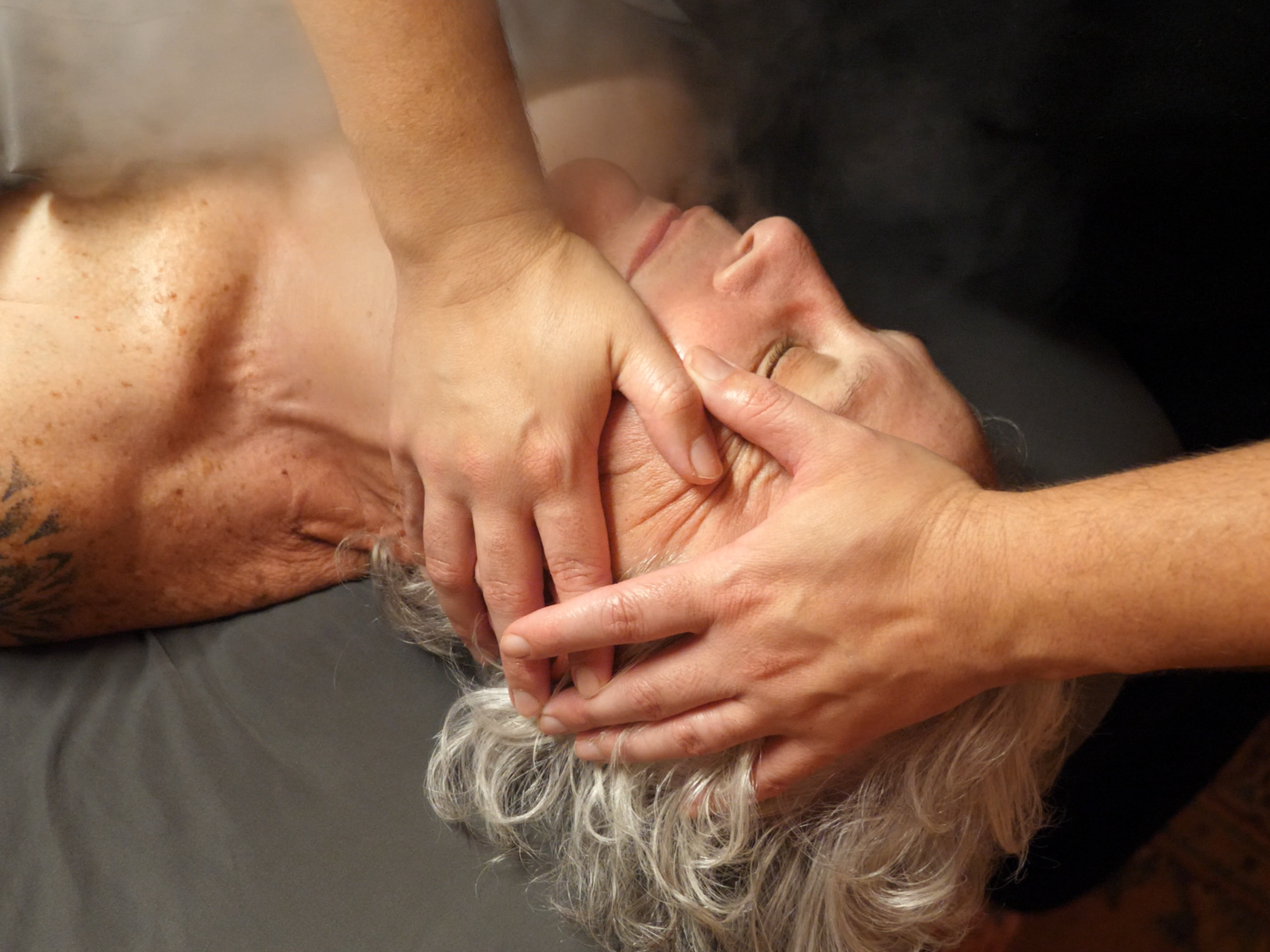
Where Can Intraoral Jaw Therapy Fit?
When a TMJ flare has a significant muscular component, hands-on work may be one supportive piece of care.
Intraoral jaw therapy allows a trained practitioner to work with muscles inside the mouth that are difficult to access directly through external massage.
At Sona Sound Spa, intraoral work is performed with gloves and informed consent. Sessions may also include external facial and jaw massage, myofascial techniques, and work through connected areas depending on the pattern of tension being experienced.
This does not mean massage treats the underlying cause of every TMD.
An irritated joint, arthritis, disc-related issue, or another medical condition requires a different kind of assessment.
But when clenching and muscular tightness are part of the picture, therapeutic bodywork can offer space for those tissues to receive focused attention.
Sometimes the jaw needs less effort.
Sometimes it needs help remembering what rest feels like.
Can Massage Make a TMJ Flare Go Away Faster?
There is not enough evidence to promise that massage will shorten a TMJ flare by a specific number of days.
That would be far too simple for a group of disorders this varied.
Manual therapy does have a place within conservative TMD care for some people. NIDCR includes physical therapy with manual techniques among nonsurgical approaches that may be considered when simpler measures are not enough.
The role of therapeutic massage is best understood as supportive.
If tight chewing muscles are contributing to how you feel, working with those muscles may help encourage relaxation and improve your awareness of the patterns that keep them active.
The goal is not to make a medical promise.
It is to give an overworked area thoughtful care.
When a TMJ Flare Deserves More Attention
Time alone should not be the only measure you use to decide whether to seek help.
A flare that is lingering but steadily improving is different from one that is getting worse.
Constant jaw pain or tenderness should be evaluated. Difficulty opening or closing the mouth fully also warrants medical or dental attention. Changes in the way your teeth fit together, significant locking, or painful changes in jaw movement deserve professional assessment.
Clicking by itself is a little different.
Jaw clicking or popping without pain is common and often does not require treatment.
The sound is not always the problem.
Pain and loss of normal function tell us much more.
What If Your TMJ Flare-Ups Keep Coming Back?
A repeating flare is information.
Maybe the jaw feels better for several weeks and then tightens again every time work becomes stressful.
Maybe mornings are consistently worse.
Perhaps the discomfort returns whenever you have been chewing gum or notice yourself clenching more often.
Recurring symptoms can be worth discussing with your dentist or another qualified provider so the larger pattern can be evaluated.
It can also be useful to become curious about what happens between flares.
How often is the jaw truly resting?
What seems to precede your symptoms?
Does the tension remain around the jaw, or do you notice it through the neck and surrounding areas too?
These observations cannot diagnose a TMD.
They can help you understand your own patterns more clearly.
The Jaw May Need Time, Not Force
When something hurts, our instinct is often to fix it immediately.
Stretch harder.
Massage deeper.
Find the exact point and make it release.
The jaw does not always respond well to being pushed.
Many TMD symptoms improve with conservative care, and the National Institute of Dental and Craniofacial Research specifically recommends starting with simple, reversible approaches rather than treatments that permanently change the teeth, bite, or jaw joint.
Sometimes healing looks quieter than we expect.
Resting the muscles.
Noticing the clench.
Allowing a tender area to settle instead of demanding that it hurry.
Supporting Jaw Tension in St. Louis
At Sona Sound Spa, Intraoral Jaw Therapy offers a gentle place to explore the muscular side of jaw tension.
The work combines external jaw and facial techniques with gloved intraoral massage when appropriate, allowing attention to move beneath the surface while honoring your comfort throughout the session.
For someone moving through a TMJ flare-up, this type of bodywork may become one part of a larger circle of care.
There may still be a dentist involved.
There may be habits that need a little more awareness.
And there may simply be a jaw asking for less work than you have been asking of it lately.
Listen while it is whispering.
Give it room.
Let softness return in its own time.
